Raw outputs are hard to compare at scale
Structural deviations, mutation properties, and model confidence do not naturally combine into a stable ranking without shared logic.
Open-source platform
Runtime-agnostic, explainable, structure-guided mutation prioritization
MHC Atlas OS is a peptide MHC decision platform that turns AlphaFold-derived structure signals into inspectable experimental prioritization outputs through explainable mutation scoring, policy-governed evaluation, and runtime-agnostic execution.
The problem
In practice, protein structure mutation analysis often fragments across notebooks, scripts, manual inspection, and disconnected model artifacts. Raw structure files, confidence values, and isolated comparisons can be informative, but they do not by themselves create a consistent, explainable structure-guided mutation prioritization workflow.
Structural deviations, mutation properties, and model confidence do not naturally combine into a stable ranking without shared logic.
Once prioritization spreads across scripts and manual inspection, the reasoning behind a decision becomes difficult to inspect or rerun.
Teams need interpretable, repeatable, policy-aware ways to turn structure-derived signals into prioritization decisions.
Why this is a big problem
Candidate review is rarely a one-shot task. Prioritization needs to be repeated, audited, compared over time, and adapted across local runs, governed execution paths, and more automated orchestration modes.
Manual or weakly structured review wastes time. Opaque ranking weakens trust. One-off scripts do not scale well. And once decisions cannot be clearly explained or replayed, experimental planning becomes harder to compare across cycles.
Repeated manual review and fragile handoffs create avoidable overhead.
Opaque ranking makes it difficult to justify why one candidate outranked another.
Runtime-specific tooling does not adapt well as review evolves from local inspection to governed or agent-capable execution.
Without stored outputs and rationale, teams relearn the same context instead of building on it.
What the platform does
MHC Atlas OS addresses the workflow problem directly: it parses structures, compares candidates, applies explainable structural scoring, evaluates policy constraints, and produces readable outputs that can be reviewed, remembered, and reused across execution modes.
Ingests PDB and mmCIF inputs, normalizes structure context, and prepares analysis-ready representations.
Measures structural change between wild-type and variant states to expose deltas that matter for review.
Combines multiple explicit signal groups into an interpretable prioritization score rather than opaque inference.
Applies domain and execution rules before recommendation output, making decision logic inspectable and governable.
Produces decision summaries and report artifacts that can be reviewed by engineers, researchers, and collaborators.
Tracks history, rationale, and prior outputs so prioritization can be revisited with context rather than guesswork.
Why governed and runtime-agnostic execution matters
Different execution modes fit different review and automation needs. Local runs support direct inspection, governed execution supports traceability and reproducibility, and agent-capable orchestration expands workflow automation. Those changes should not require rewriting the core decision logic.
Scoring and comparison logic should remain stable even when orchestration changes.
Governance matters when prioritization outputs need to be reviewed, rerun, and defended.
Different runtime modes fit different stages of inspection, control, and automation.
Agent-capable execution is valuable only if the underlying decision logic remains understandable.
Architecture overview
MHC Atlas OS separates runtime concerns from domain logic so the same scoring, policy, and reporting core can operate across local execution, governed runtime contexts, and collaborative agent orchestration.
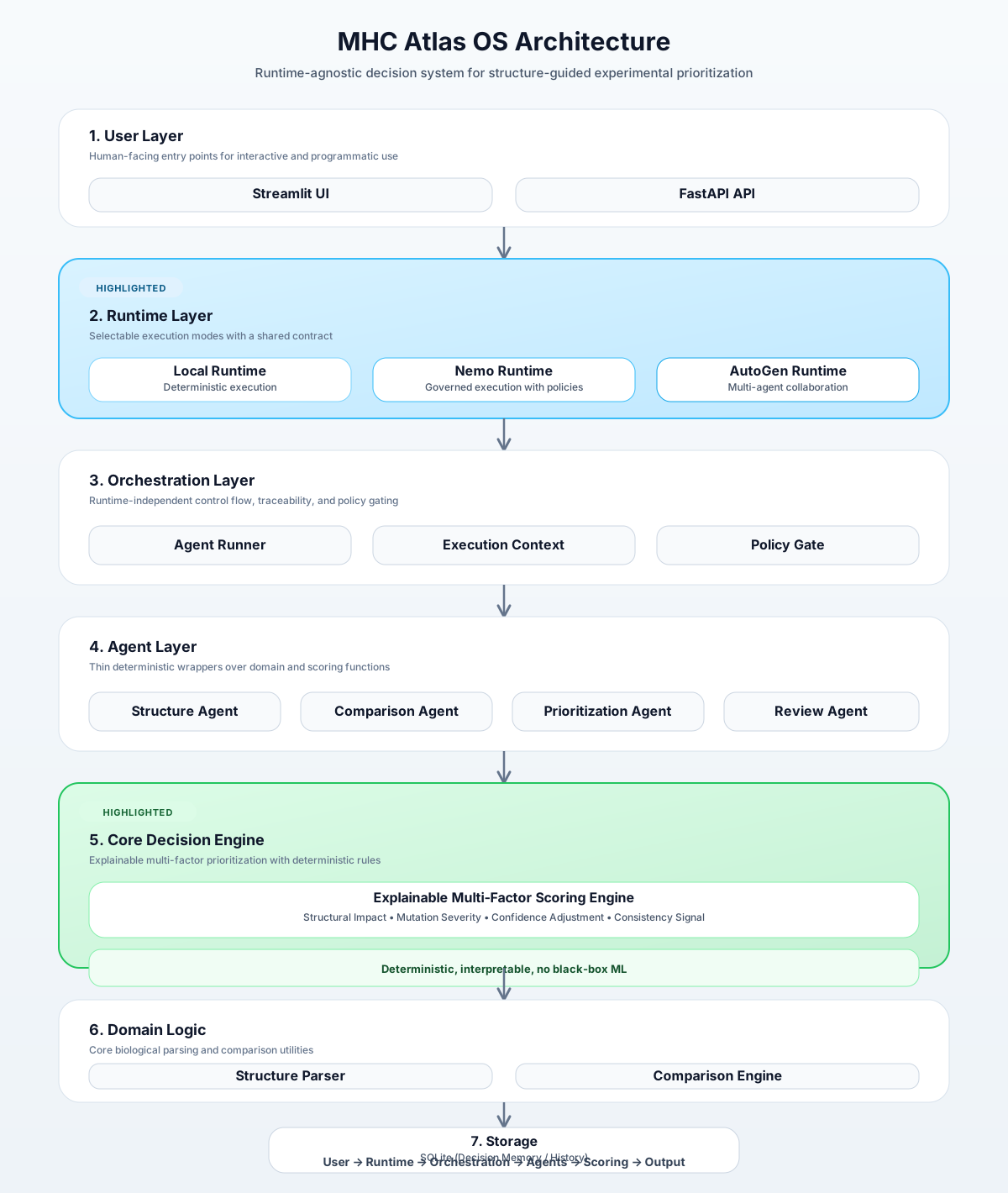
The architecture figure is expected at docs/architecture.svg.
Abstracts execution from implementation details so local, governed, or multi-agent modes can share the same core pipeline.
Coordinates task routing and collaboration while preserving explicit boundaries around who evaluates what.
Holds structure parsing, comparison, and prioritization logic in deterministic modules rather than runtime-specific glue.
Encodes decision rules, gates, warnings, and governance so output can be defended and re-evaluated consistently.
Generates reports, API responses, UI views, and decision memory artifacts that make the system operationally usable.
Runtime modes
Runtime abstraction is a product strength here, not a side detail. It keeps the platform portable while preserving deterministic domain logic and explainable output semantics.
Local Runtime
Direct pipeline execution for development, testing, reproducible evaluation, and low-friction local use.
Nemo Runtime
Introduces execution context, policy enforcement, warnings, traceability, and a more controlled decision path.
AutoGen Runtime
Supports agent-driven evaluation patterns where multiple task roles contribute to the final structured output.
Scoring model
The scoring system is designed to expose structured signals that help decide what to validate next. It does not claim to predict binding affinity or biological outcome directly.
Geometric change signals capture the degree and character of structural difference between wild-type and mutant states.
Residue-class transitions provide explicit mutation severity cues rather than hiding the rationale inside a learned model.
Model reliability indicators shape how strongly a result should influence prioritization and review attention.
Agreement across multiple indicators helps distinguish stable prioritization signals from noisy or ambiguous cases.
Design philosophy
Priority comes from explicit, reviewable signals rather than opaque prediction layers.
Every score should be legible enough to support discussion, skepticism, and revision.
Recommendations should pass through declared rules, not just internal heuristics.
The execution framework can change without forcing a rewrite of domain reasoning.
Core biology and scoring modules remain stable, testable, and portable across orchestration modes.
What this is not
MHC Atlas OS is intentionally positioned as a decision-support system for structured prioritization. That distinction matters for technical evaluation and for scientific credibility.
It does not claim direct affinity prediction or biological truth. It emits structured prioritization signals for validation planning.
Ranking logic is explicit, multi-factor, and policy-aware rather than buried inside a fixed heuristic stack.
Runtime abstraction is built into the architecture so the platform is not trapped inside one orchestration choice.
The system includes decision logic, reporting, and memory instead of stopping at inspection or visualization.
The platform is organized around reusable workflows, policy gates, and artifacts that support repeatable review.
Workflow / execution flow
Provide wild-type and mutant structure data with the candidate context that frames the evaluation task.
Choose local, governed, or multi-agent execution based on the level of control, traceability, and orchestration required.
Dispatch through the appropriate orchestration layer while keeping the domain core stable.
Parse files, compare state changes, and assemble the raw signals required for scoring.
Integrate structural, biochemical, confidence, and consistency signals into a readable prioritization output.
Gate, warn, or annotate results according to declared rules before anything is presented as a decision artifact.
Produce reports, API/UI outputs, and saved decision history for review, comparison, and follow-on work.
Artifacts / resources
Source tree, issues, releases, and implementation details.
Site deployment notes and homepage maintenance instructions.
Fastest path to a demo workflow and first execution.
Environment and package installation options.
Command-line entry points and usage patterns.
Walkthroughs and evaluation scenarios.
Structured evaluation path for collaborative review.
Versioned changes, maturity signals, and evolution history.
Project status / roadmap
Core runtime, orchestration, scoring, reporting, and storage layers are already visible as distinct system boundaries.
Scoring and decision outputs are positioned around readable rationale instead of opaque predictive claims.
Future work can expand runtime integrations, plugin surfaces, and scoring policy modules without collapsing the core architecture.
Contact / contribution
Contributions, evaluation feedback, and architecture discussion are best routed through the repository. Replace the placeholder contact below if you want a direct collaborator or diligence contact.
Licensed under MIT where applicable in the repository.