SRAM Interface Demo
A memory-control-plane prototype for explicit SRAM-style residency.
Explicit Memory Residency, Not Just Implicit Caching
Modern systems usually hide memory placement behind caches, coherence, and implicit hardware policy. This prototype explores the opposite: a small software-visible interface for reserving, binding, and verifying SRAM-like residency regions.
Why This Exists
The Problem with Caches
CPUs hide placement through complex hardware heuristics (L1/L2/L3), coherence protocols, and speculation. For general workloads, this is magic; for deterministic AI workloads, it's a bottleneck.
AI Infrastructure Needs
AI workloads like KV cache tiles, tensor tiles, and expert weights benefit from explicit placement to minimize tail latency and maximize throughput.
Software-Defined Residency
This repo demonstrates a tiny software control plane that gives applications direct control over where data lives in the hardware hierarchy.
What the Prototype Includes
Mock SRAM Backend
A portable userspace implementation using calloc. Runs on any OS for rapid architecture testing and CI.
/dev/mem MMIO Backend
A hardware-facing Linux path that maps physical address ranges (FPGA BRAM, PCIe BAR, SoC SRAM) into userspace.
mem_hint API
A clean C API for residency intent: reserve, bind, write, read, and verify.
CLI Demo
A runnable demonstration of the entire flow in mock mode, including AI-centric examples for KV caches and tensors.
Architecture
The stack bridges the gap between high-level AI runtimes and low-level hardware memory apertures.
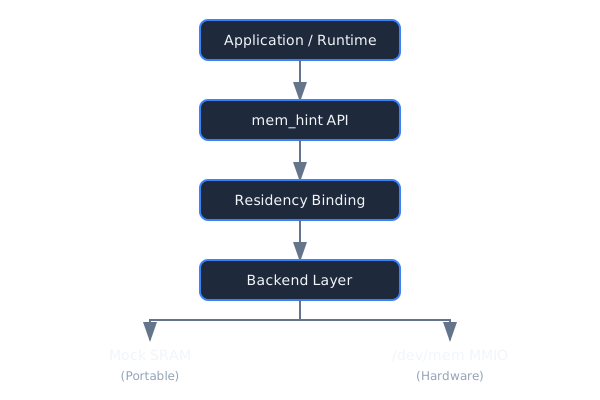
Demo Flow
A typical interaction involves reserving a region, binding it to a backend, and managing data residency.

$ make
$ ./sram_demo

[mem_hint] reserve "kv_tile_0" → SRAM
[mem_hint] bind → offset 0x100
[mem_hint] write → 39 bytes
[mem_hint] readback → verified ✔
Backend Comparison
| Backend | Platform | Purpose | Status |
|---|---|---|---|
| Mock SRAM | Any OS | Development/testing | Implemented |
| /dev/mem MMIO | Linux | Hardware SRAM aperture | Implemented |
| UIO/VFIO | Linux | Safer hardware mapping | Planned |
| /dev/mem_hint | Linux Kernel | Explicit residency control | Planned |
Use Cases
KV-Cache Tile Residency
Explicitly binding active LLM attention blocks to fast on-chip memory.
Tensor Tile Staging
Overlapping data movement with compute by manually staging tiles in SRAM.
MoE Expert-Weight Promotion
Promoting active expert weights to fast residency before execution.
FPGA Scratchpad Memory
Managing non-coherent FPGA local memory from host software.
Near-Memory Accelerator
Pushing operands into local accelerator memory apertures.
Compiler-Directed Placement
Automated residency hints emitted by AI compilers like XLA or Triton.
Mock Benchmark
A low-level latency benchmark measures the overhead of the memory-control-plane logic in mock mode. This is useful for validating the control path overhead, though it does not reflect physical hardware latency.
$ ./latency_bench 1000000

[bench] backend: mock SRAM
[bench] iterations: 1000000
[bench] write32 avg: 4.52 ns/op
[bench] read32 avg: 3.10 ns/op
[bench] verify: OK ✔
Safety & Limitations
⚠️ This is not a production driver. It is a design sketch for a memory control plane.
Raw /dev/mem access is dangerous and should be replaced by UIO/VFIO or a dedicated kernel driver in real systems.
Mock mode is provided for portability and architectural demonstration only. The future /dev/mem_hint interface is conceptual.
Roadmap
-
Mock SRAM Backend
Fully functional userspace simulation.
-
/dev/mem Backend
MMIO support for physical hardware apertures.
-
CI + Examples
GitHub Actions integration and AI-centric demo code.
-
UIO/VFIO Backend
Moving towards safer hardware mapping interfaces.
-
/dev/mem_hint Kernel Interface
Conceptual character device for safe residency management.