Patent Microsite · Enterprise AI Middleware
One Query. Ten Agents. Zero Waste.
WDC-Engine eliminates redundant execution across your AI agent fleet — before it reaches your database.
How It Works
Semantic equivalence detection, bounded admission, one execution, full fan-out.
WDC-Engine sits between the agent layer and enterprise backends. It fingerprints incoming work, prospectively detects exact or near duplicates, holds the first unique task inside a bounded temporal admission window, and collapses sister requests into a shared execution unit before any redundant backend work begins.
1. Semantic Fingerprinting
Task Ingress Registry and the Semantic Fingerprinting Module normalize incoming SQL, API, and natural-language tasks into exact and similarity-friendly representations.
2. Temporal Ghosting
The first unique request is held in a bounded non-resetting admission window so closely arriving sister tasks can be attached before execution begins.
3. Shared Execution Unit
Collapse Manager and SEU-M create one live execution path for the matched task family instead of allowing every agent to issue the same backend query independently.
4. Result Fan-out
Once the execution completes, the Result Fan-out Module returns the full response to every subscribed agent while preserving transparent middleware behavior.
How Temporal Ghosting Works
Equivalent tasks cluster in time. Temporal Ghosting captures them before the backend fires.
The timeline below shows a single admission window capturing three related requests. Agent B and Agent C receive a deferred response because they collapse into the same shared execution unit initiated by Agent A.
Temporal Ghosting Window
Agent A
Task arrivest=50ms
Full result delivered
Agent B
Task arrivest=200msDEFERRED
Full result delivered
Agent C
Task arrivest=250msDEFERRED
Full result delivered
1 backend query
Deduplication Multiplier: 3×
SQL Normalization — See It Live
Structural normalization surfaces exact matches before expensive backend work begins.
This client-side demo simulates the same normalization flow described in the patent: lowercase conversion, whitespace collapse, alias canonicalization, predicate reordering, and literal abstraction.
SELECT customer_id, SUM(amount) AS total FROM transactions WHERE DATE(created_at) >= '2024-01-01' AND region = 'West' GROUP BY customer_id;
Awaiting normalization
Structural Hash:
pending—
select CUSTOMER_ID,sum(AMOUNT) total from TRANSACTIONS t where t.region='West' and date(t.created_at)>='2024-01-01' group by CUSTOMER_ID;
Awaiting normalization
Structural Hash:
pending—
SELECT c_id, SUM(amt) FROM txns WHERE txns.region = 'West' AND DATE(txns.created_at) >= '2024-01-01' GROUP BY c_id;
Awaiting normalization
Structural Hash:
pending—
What just happened?
- Lowercase: SQL keywords and identifiers are normalized for stable comparison.
- Whitespace collapse: formatting differences are stripped away.
- Alias canonicalization: transient table aliases are normalized so they do not create false uniqueness.
- Predicate reordering: semantically equivalent
WHEREclauses are ordered consistently. - Parameter abstraction: literals become placeholders such as
:DATE_1and:STR_1.
Architecture
Middleware-level collapse before execution starts.
The main path flows left to right from task ingress to result fan-out. The collapse path branches from similarity detection into the WIP-Cache and Result Fan-out Module when a match is found before a new SEU launches.
Exact and near-equivalent match path
Exact structural hash matches resolve immediately, while natural-language and multi-modal tasks use similarity search to detect near duplicates that should collapse prospectively.
Distributed admission control
In distributed deployment, fingerprint-scoped locks and synchronized admission state prevent competing nodes from launching duplicate SEUs for the same semantic task family.
By The Numbers
Deduplication multiplier is the operating metric that matters.
These illustrative metrics show how one shared execution can remove repeated warehouse, API, and compute work across a busy enterprise agent fleet.
Figures based on a simulated enterprise deployment with 12,847 tasks/hr across 20 concurrent AI agents.
How WDC-Engine Differs
WDC-Engine operates prospectively, semantically, and across the full agent fleet.
Conventional caches and request-coalescing mechanisms reduce repeated work after the fact or at narrow protocol layers. WDC-Engine combines semantic equivalence detection, bounded temporal admission, and cross-agent result fan-out before redundant execution starts.
| Capability | Key Caches | Singleflight | Task Queues | Semantic Cache | Multi-Agent Frameworks | WDC-Engine |
|---|---|---|---|---|---|---|
| Semantic near-duplicate detection | ✗ | ✗ | ✗ | ✓ | ~ | ✓ |
| Temporal admission window | ✗ | ✗ | ✗ | ✗ | ✗ | ✓ |
| Prospective (pre-execution) dedup | ~ | ~ | ✗ | ~ | ✗ | ✓ |
| Multi-agent result fan-out | ✗ | ✗ | ~ | ✗ | ~ | ✓ |
| Cross-agent task collapse | ✗ | ✗ | ✗ | ✗ | ~ | ✓ |
| Transformer-based embedding | ✗ | ✗ | ✗ | ✓ | ~ | ✓ |
| SQL/NL/API multi-modal support | ✗ | ✗ | ~ | ~ | ~ | ✓ |
| Agent-transparent middleware | ✗ | ✗ | ✗ | ✗ | ✗ | ✓ |
| Deduplication multiplier metric | ✗ | ✗ | ✗ | ✗ | ✗ | ✓ |
| Distributed TAC sync | ✗ | ✗ | ~ | ✗ | ✗ | ✓ |
| No agent code changes required | ~ | ~ | ✗ | ~ | ✗ | ✓ |
Try the Prototype
One repository, two surfaces: public microsite and local concept demo.
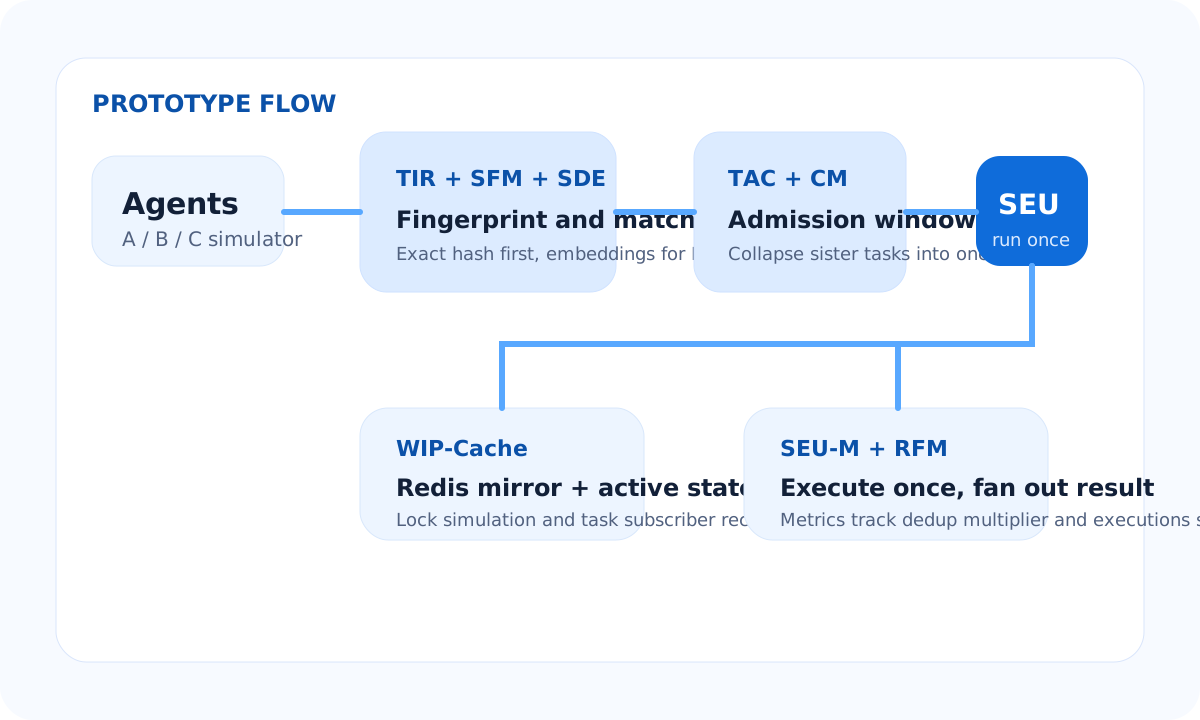
The root site explains the architecture publicly, while the bundled prototype demonstrates task ingestion, semantic matching, Temporal Ghosting, shared execution units, Redis-backed coordination, and result fan-out in a local environment.
Prototype topology
Bring up the local stack
cd prototype
cp .env.example .env
docker compose up --build
Submit a task through the ingress API
curl -X POST http://localhost:8000/api/tasks ^
  -H "Content-Type: application/json" ^
  -d "{\"agent_id\":\"Agent A\",\"task_type\":\"SQL_QUERY\",\"payload\":\"SELECT customer_id, SUM(amount) AS total FROM transactions WHERE DATE(created_at) >= '2024-01-01' AND region = 'West' GROUP BY customer_id;\"}"
Python stub for agent-side submission
import requests

payload = {
    "agent_id": "Agent B",
    "task_type": "NATURAL_LANGUAGE",
    "payload": "Pull all open support tickets for the West enterprise segment."
}

response = requests.post(
    "http://localhost:8000/api/tasks",
    json=payload,
    timeout=10,
)

response.raise_for_status()
task = response.json()
print(task["status"], task["seu_id"])
Patent
Public technical overview aligned to the filing narrative.
The microsite is designed as a public engineering-facing explanation of the invention, not as a legal filing packet. It emphasizes semantic equivalence detection, Temporal Ghosting, shared live execution, distributed synchronization, and the deduplication multiplier operating metric.
Why publish it this way
Enterprise evaluators, patent reviewers, and systems engineers need the architecture explained as an operating system, not a wall of claims. This page turns the patent concepts into an inspectable technical narrative.
Central novelty thread
WDC-Engine combines semantic equivalence detection, a bounded temporal admission window, shared execution units, result fan-out, and distributed coordination so overlapping agent work can collapse before redundant backend work starts.